

For over two decades I’ve amassed a lot of travel tips and techniques. For context, I travel a lot, for both family vacations and business. Below is a comprehensive guide to traveling like a pro, fully refreshed for 2026 with the latest apps, services, programs, and credit cards.
Just How Much Do I Fly?
I track everything in Flighty, which lets me look at the receipts. Here’s what the Flighty Passport says:
All-time: 625 flights, 1,219,222 miles, 153 airports, 47 airlines, 116 days of flight time.
Recent pace: 66 flights in 2024, 61 in 2025, and 28 in 2026 through May.
Fun facts: That mileage is 49 trips around the Earth, 5.1 trips to the Moon, or half an orbit of the Sun. Average flight: 1,951 miles. Shortest: Adelaide to Kingscote on Qantas (78 miles, a delightfully tiny island hop). Longest: Seattle to Singapore on Singapore Airlines flight SQ 27 (8,065 miles, the kind of flight that requires real planning).
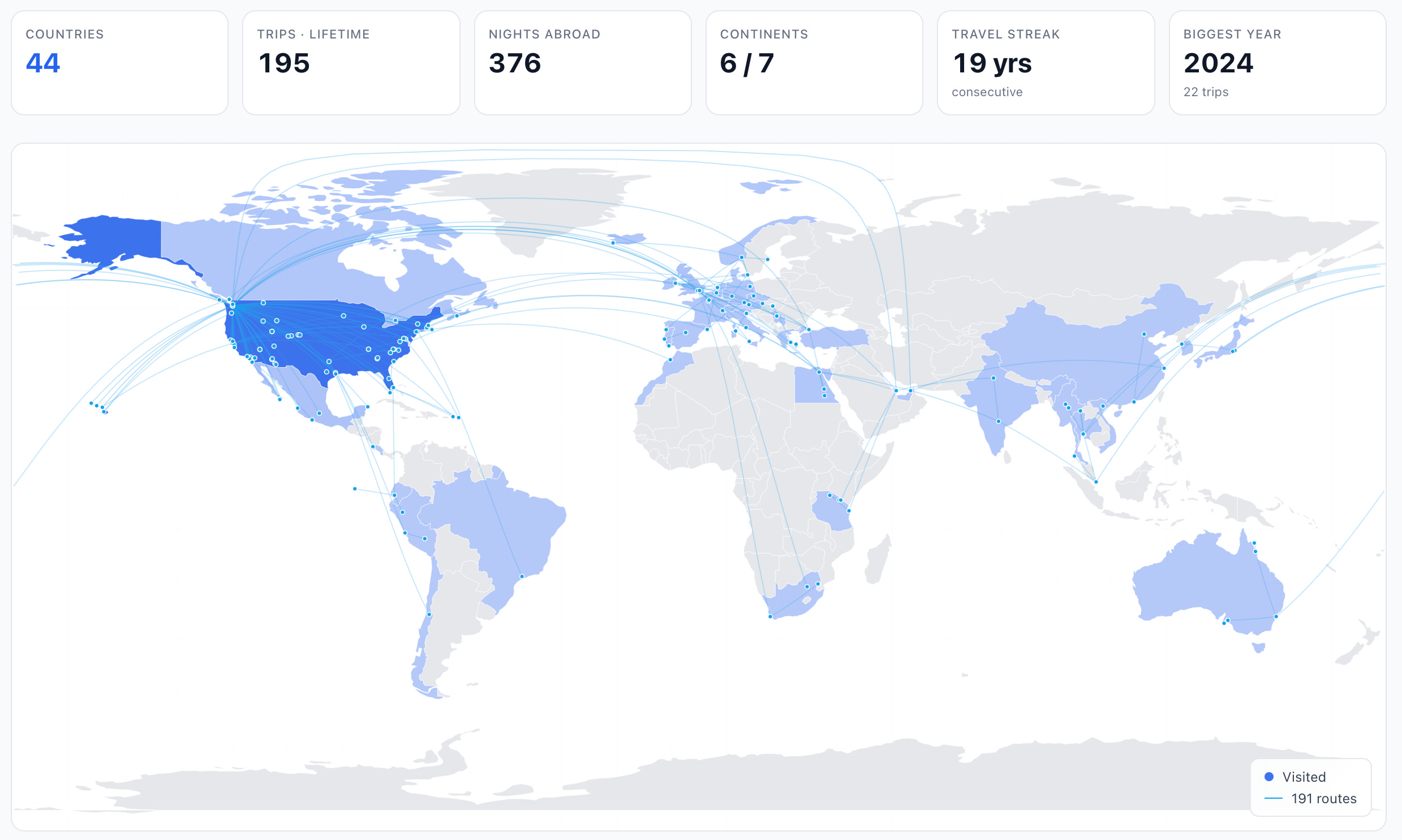
The mix is roughly half short-haul domestic (SEA to SFO is my single most-flown route, 93 flights both directions) and half long-haul international, where SEA to LHR leads with 27 flights round-trip. My top carriers are Alaska, Virgin America (RIP), British Airways, and Delta.
That’s the lens for everything below. The recommendations are shaped by actually using these products, programs, and services across more itineraries than I can keep track of, and getting burned often enough to know which ones really matter.
The last time I wrote a top-to-bottom version of this guide was January 2017 in Pro Traveler Tips. A lot has changed in nine years. Premium credit cards now come with annual fees north of $800. Alaska bought Hawaiian and rebranded the loyalty program to Atmos Rewards. As a Titanium member I now get oneworld Emerald, which is the most achievable path to top-tier alliance status if you live on the West Coast. TSA PreCheck Touchless ID is finally rolling out at scale, which makes CLEAR feel a lot less essential. And Blacklane has quietly replaced rideshare as my default for airport ground transport. Time for a refresh.
If you’re short on time, here’s the TL;DR:
Apply for Global Entry or Nexus. These trusted traveler programs speed you through immigration (Nexus is a USA / Canada program for cross-border travel) and include TSA PreCheck for domestic security. This is still the single best investment you can make in your travel experience.
Use TSA PreCheck Touchless ID where available. As of 2026 it’s expanding quickly at select airports across Delta, United, American, Alaska, and Southwest. Once your boarding pass shows the Touchless ID indicator, you walk up, look at a camera, and the identity check is done. You still carry physical ID as a backup, but the experience is much closer to the future, and it’s free with PreCheck.
CLEAR is now optional. Touchless ID covers much of what I used CLEAR for, and at no extra cost. CLEAR still helps at airports where Touchless hasn’t landed yet or in the non-PreCheck lanes. If your premium card reimburses the fee (Amex Platinum still gives you $209/year for CLEAR+ in 2026), keep it. Otherwise, drop it.
Get a premium travel credit card. The two flagships, Amex Platinum and Chase Sapphire Reserve, both got more expensive in 2025/2026 but added meaningful new credits. If you’re loyal to one airline, also carry that airline’s top co-brand. For me that’s the Delta SkyMiles Reserve and the new Alaska Atmos Summit Visa Infinite.
Pick one airline and chase top-tier status. For a Seattle-based traveler, Alaska’s Atmos Titanium is the move. It earns you oneworld Emerald, which gets you and a guest into business class lounges flying internationally on any oneworld carrier, even in economy.
Use Blacklane for airport ground transport. It’s now my default for arrivals and early-morning departures. Booked in advance, professional driver, your name on a sign, flight tracked. No surge pricing, no rideshare lottery.
Use a reliable flight-tracking app. Subscribe to Flighty Pro for real-time flight alerts (it often notifies you of delays or gate changes before the airline does). It also has amazing stats and visualizations of your travel.
Invest in good noise-cancelling headphones and good luggage. A quality pair of headphones makes flights far more pleasant. A durable spinner carry-on (Rimowa, the new Peak Design Roller Pro, or Away) lets you glide through airports and skip baggage check when possible.
With those high-level tips in mind, let’s dive into the details on how to make every stage of your travel smoother and more enjoyable.
Lines and Queues: How to Avoid Wasting Time
I hate waiting in lines at the airport, truly despise it. The good news is you can avoid many of them with some strategy. Here’s how to skip or shorten every queue from your front door to your plane seat:
Parking: If you drive to the airport, consider parking in the on-site garage or a nearby lot that offers a quick shuttle. Yes, it costs more than remote economy lots, but it can save a lot of time.
Check-In: Check in for your flight online or via your airline’s mobile app as early as possible (usually 24 hours before departure). This way you can skip the check-in counter entirely. Load your mobile boarding pass to your phone’s wallet. If you have checked luggage, print your bag tags at a kiosk (or even at home, if your airline allows) to save time. Alaska Airlines, for example, lets you print tags in advance. Then just drop the bag at the designated counter. As an Atmos Titanium member I now use the new Suites & Titanium check-in at SEA (opened April 2026), which puts me behind sliding glass doors with a personal concierge and a private security checkpoint that bypasses even the PreCheck line.
Security (TSA): Here’s where those trusted traveler programs pay off. TSA PreCheck is essential. Better still, Global Entry or Nexus include TSA PreCheck in addition to fast-tracking you through passport control on international trips. Expanded in 2026: TSA PreCheck Touchless ID is now available at select U.S. airports with participating airlines. If your boarding pass has the Touchless ID indicator, you walk up to a dedicated camera, it matches your face against your passport photo, and you’re through the ID check with much less fumbling. It’s free with PreCheck. CLEAR used to be the only way to skip the ID line, but Touchless ID now covers much of that use case without an annual fee, so CLEAR is more of a “nice if you can get it comped” perk than a must-have.
Boarding: The scramble for overhead bin space is real. To board earlier and avoid having to gate-check your carry-on, either fly enough to earn elite status or consider paying for priority boarding if available. Premium cabin tickets and most airline co-brand cards also get you into earlier boarding groups. Getting on the plane early means you can stow your bag and settle in without feeling rushed.
Seating: If a quick exit on arrival matters to you, try to sit toward the front of the plane. Even in economy, being in the first 5 to 10 rows can save you 10 minutes of deplaning time compared to the back. Many airlines now charge extra or reserve these forward rows for status passengers, but it can be worth it if time is critical (or if you have a tight connection). Sometimes even an exit row or bulkhead seat gets you out faster.
Baggage Claim: The ultimate time-saver is to not check a bag at all, if you can manage a trip with a carry-on only. But when you do check luggage, one trick for families or groups: have one person go straight to the rental car center or curbside pickup while another waits for the bags. For example, when my family travels, I’ll head to pick up the rental car as soon as we deplane, while Lora waits for our suitcases. By the time she steps outside with the bags, I’m already pulling up curbside.
Car Rental: Avoid the rental counter lines by joining the rental company’s loyalty program in advance. Most major car rental companies (Hertz Gold Plus Rewards, Avis Preferred, National Emerald Club) let you go straight to the lot and pick up your car without stopping at the desk. Often your contract and keys are waiting in the car or at a kiosk. This is usually free to sign up, and some credit cards grant you status that can mean nicer cars or upgrades. Skipping the 30-minute queue at the rental counter after a long flight is a godsend.
Immigration & Customs: If you travel internationally, Global Entry is the holy grail for avoiding immigration lines in the U.S. Instead of standing in a long queue to see an officer, you’ll use a kiosk or the Global Entry Mobile app and be out in minutes. It costs $120 for 5 years (most premium cards reimburse this), and it includes TSA PreCheck. If you live near Canada or travel there often, Nexus is incredibly worth it.
AirTags: AirTags have become an essential tool for travelers due to their ability to provide real-time tracking of personal belongings, especially luggage. Recently, the integration of AirTags with airline systems lets you share your lost luggage’s location to the airline. Because, let’s face it, they have no idea where your bag is.
By implementing these tactics, you’ll breeze through the airport. What to do with all that extra time on your hands? Perhaps hit the lounge for a pre-flight snack or drink, or just relax at the gate knowing you didn’t spend your morning inching forward in five different lines.
When You Want White-Glove Service: Airport Concierge
For certain trips, especially ones with elderly parents, kids traveling alone, complicated international connections, or just a really tight schedule, an airport concierge can pay for itself in stress saved. These services were once strictly the domain of celebrities and ultra-high-net-worth travelers, but a few are now reasonably priced and worth knowing about.
American Airlines Five Star Service: AA’s white-glove concierge at 16 U.S. airports plus six international. Check-in at the Flagship First counter, Admirals Club access, priority screening, escort to the gate, planeside pickup with a golf cart on arrival. $350 first adult, $100 each additional. You must be flying business or first on American or a oneworld carrier. Five Star Select (ORD, DFW, MIA, LAX) adds Flagship First Dining and an in-airport cart and runs $650 first adult. I’ve used this in Miami and it was excellent: planeside golf-cart pickup, direct ride to the lounge, then escort back to the gate with Concierge Key boarding.
Delta VIP Select: Delta’s equivalent, available at ATL, DTW, MSP, JFK, LGA, SFO, SLC, LAX, and SEA. $500 first passenger, $100 each additional. Meet & greet at curb or gate, porter, Sky Club access, flight monitoring, and rebooking help if things go sideways. Must be a Delta-marketed and operated flight. Book at least 6 hours out.
United Signature Service: ~$400 first passenger at 22 airports including ORD, JFK, SFO, LHR, CDG, AMS. Premier check-in, United Club, priority security, Group 2 boarding. United flights only.
SkySquad (budget option): Around $179 per segment for curb-to-gate or gate-to-curb help at five U.S. airports (BWI, FLL, LAS, LAX, MCO). Bag help, security navigation, family chaperoning, useful for unaccompanied minors and elderly parents. Two-hour cap, 24-hour booking minimum.
CLEAR Concierge: Often overlooked. $99 (Express) or $179 (Gate Service) at 22 U.S. airports, departures only. You and up to 9 travelers get curb-to-Clear-lane-to-gate escort. All travelers must be CLEAR members.
SkyVip (the luxury option): Global multi-tier service in 100+ countries. The top “Private Suite” tier at LHR is roughly $5,235 and includes a private suite, private vehicle to the aircraft, and full bag handling. Use case: very high-touch arrivals (e.g., parents on a once-in-a-lifetime trip, or you really don’t want to deal with Heathrow’s main terminal). Meet & Greet tier at SEA is more modest, around $475.
When to actually use these: I’ve used AA Five Star at MIA (excellent), and considered the Cairo VIP Departure at CAI (where airport security can be a 20-minute chaotic ordeal). For routine business travel I don’t bother. For complicated family trips, an aging parent traveling solo, or an unfamiliar high-stress airport, the cost is trivial compared to the friction it removes.
Travel Planning: Tools for Flights, Hotels and Food
Good travel outcomes start with good planning. Luckily, we have great apps and services now that make planning trips (and eating well when you get there) much easier than in years past. Here are my go-to tools for trip planning in 2026:
Google Flights & Price Alerts: When shopping for airfare, I use Google Flights extensively. It’s fast, has a great calendar view of fares, and lets you track prices. Turn on price alerts for routes or dates you’re eyeing. Google will email you if prices drop or if it predicts a fare won’t get much lower. This takes a lot of the guesswork out of whento book. Also, Google Travel will automatically organize your itineraries if your confirmation emails go to Gmail.
Award Booking Windows (pro tip): If you’re chasing premium-cabin award space using points, the trick is to book the moment an airline opens its schedule. Each airline has a different window:
Cathay Pacific: 360 days out (longest window in the industry)
Flying Blue: 359 days
British Airways / Qantas / ANA: 355 days
United: 337 days
American / Delta / Virgin Atlantic: 331 days
Alaska: 330 days
Set a calendar reminder for 361 days before your trip and you’ll often catch the best business and first cabins before the dealers and bots clean them out.
AeroLOPA (seat maps): When I’m picking a seat on a long-haul, I never trust the airline’s seat picker. I go to AeroLOPA, which has the most accurate, detailed seat maps anywhere on the internet. Stagger patterns, overhead bin coverage, lavatory placement, every quirk per aircraft type. It’s how I figure out that on Turkish A350, seat 4A is dramatically better than 3A even though both are window seats (4A is tucked against the window, 3A is shoved toward the aisle). For a $5,000 business class ticket, it’s worth five minutes of seat-map study.
FlightQueue (TSA wait times): FlightQueue shows real-time TSA security wait times across major U.S. airports. Useful for deciding when to leave for the airport on a busy day, and for figuring out whether to roll the dice on standard PreCheck or pay the CLEAR/Touchless ID premium.
Michelin Guide App: For finding exceptional restaurants and hotels, the Michelin Guide mobile app is a gem. It puts the entire Michelin Guide (every starred and Bib Gourmand restaurant around the world) in your pocket, complete with maps and the ability to book reservations. The big 2024-2025 update was the introduction of the Michelin Key for hotels, the hotel equivalent of a Michelin Star. As of late 2025 the program went fully global, with 2,457 Keys awarded across 120+ countries (One Key for a special stay, Two for exceptional, Three for extraordinary). The app now surfaces over 7,000 Michelin-selected hotels alongside the restaurants, with proper editorial reviews and direct booking. It’s quickly become my go-to second opinion on a hotel I’m considering, especially for trips where I don’t have a concierge planning for me.
Beli: Beli is the restaurant-tracking app I didn’t know I needed. It’s part personal dining diary, part social network. You rate restaurants you’ve been to (the app uses a clever head-to-head comparison system instead of star ratings, so your rankings are actually meaningful), build a “want to try” list, and see what your friends are eating. Where it really shines is when you travel: open the map in a city you don’t know and you immediately see the spots your trusted friends have loved, plus Beli’s own algorithmic recommendations based on your taste. It’s replaced a lot of the trial-and-error I used to do with Yelp and Google reviews. Free on iOS and Android.
Eater (app or website): For a more casual and local take on dining, Eater is fantastic. Eater’s editorial teams produce city guides and “essential” restaurant lists that highlight where the locals actually eat. Instead of sifting through hundreds of random Yelp reviews, you can trust Eater’s curated picks, whether you’re looking for the hottest new ramen joint, a classic taco stand, or the must-try brunch spot.
Local Foreigner (Travel Concierge Service): Sometimes the best travel planning move is to hand it off to an expert. We use Local Foreigner for many trips now, not just the big ones. Weekend getaway? They book the hotel and get us the inside scoop. Multi-country two-week vacation? They handle the itinerary, transfers, guides, dinner reservations, and 24/7 support. The thing that surprised me is how much value they add even on a simple two-night hotel booking. They have direct relationships with most luxury hotels and brands (Four Seasons, Rosewood, Aman, Belmond, Auberge, etc.) which means we get FHR-style perks (breakfast, upgrades, property credits, late checkout) on properties even outside the Amex FHR program. Their team expertly handles every detail so I don’t have to think about logistics. For our family, having Local Foreigner on retainer for everything has been one of the single biggest quality-of-life upgrades in how we travel.
TripAdvisor (use selectively): I have a love/hate with TripAdvisor, but it’s worth mentioning. It’s no longer theprimary research tool it once was, but it still has a massive amount of user reviews. I’ll sometimes glance at TripAdvisor for things to do or to sanity-check a hotel’s quality via recent reviews. Take everything with a grain of salt and focus on recent, detailed reviews.
Using these planning tools, you can piece together a pretty incredible trip: flights at the best price, a well-located hotel, can’t-miss restaurants booked in advance, and maybe even some cool experiences reserved.
Travel Apps: Must-Haves for Your Journey
Once your trip is booked and you’re on the move, a few apps can make the execution of travel much smoother. These are the core travel apps I keep on my phone:
Flighty (Pro): Still my favorite flight tracking app. Flighty is like having an expert flight dispatcher in your pocket. It monitors your flights in real-time and sends the fastest alerts for delays, gate changes, and cancellations, often before the airline notifies you. Flighty pulls data from FAA systems, Flightradar, and historical trends to give you a heads-up about issues. I highly recommend paying for Flighty Pro, which unlocks all the alert features. They even offer a lifetime family subscription. If you travel often, it’s worth it for the peace of mind. Flighty has literally alerted me to rebook on another flight while everyone else at the gate was still in the dark.
Flightradar24 and FlightAware: These are excellent complementary tools to Flighty. Flightradar24 is a live flight tracker with a global map of air traffic. FlightAware similarly provides live tracking with historical on-time statistics. Flighty is my proactive alert system, and these two are my on-demand tools to dig into flight data when I need more detail.
Google Maps: Google Maps is still the ultimate travel companion app. It’s not just for driving directions: it’s public transit schedules, walking routes, neighborhood exploration, and even restaurant discovery all in one. Download offline maps of your destination city before you go. Star or save all the places you might want to visit (sights, hotel, restaurants from Eater or Michelin). They’ll show up on the map, which helps in planning your days.
Google Translate: Language barrier? Not with this app. Google Translate has a feature where you can use your camera to translate text in real time. It will literally overlay the translation on signs or menus in augmented reality. It can also do two-way speech translation. Download language packs for offline use so it works without data.
Rideshare Apps: An absolute must for spontaneous ground transportation in most cities. For anything I can schedule in advance (early morning airport runs, evening returns), Blacklane is my go-to. For everything else, Ubercovers the gap. In some countries, local rideshare apps (Grab in Southeast Asia, Bolt in parts of Europe and Africa) are key.
Airline and Hotel Apps: Make sure to install the apps for any airlines you’re flying and hotels you’re staying at. Airline apps are useful for mobile boarding passes, real-time flight updates, and same-day flight changes. Hotel apps (Marriott Bonvoy, Hilton Honors, World of Hyatt) let you check in digitally, sometimes choose your room, and use a digital key.
Frequent Flyer Status: Pick One Airline
The single biggest unlock for traveling well, beyond credit cards, is having top-tier elite status with one airline. The trick is to concentrate your flying, not spread it across every carrier.
For a few years I credited everything to American Airlines and got to Executive Platinum, which is American’s top tier and confers oneworld Emerald. That worked, but as a Seattle resident it always required some flight gymnastics. After Alaska bought Hawaiian and rolled both programs into Atmos Rewards, the calculus changed.
Alaska Atmos Titanium (my pick): Titanium is the top tier in Alaska’s Atmos program. The headline benefit is complimentary upgrades for me and one companion on every global route operated by Alaska or Hawaiian, including day-of-departure upgrades to Suites and Business Class on the new long-hauls to Asia, Europe, and Oceania. No points or certificates needed. You also get three free checked bags, 150% bonus points on every flight (including partner flights), a complimentary drink and West Coast-inspired meal in Main Cabin, free same-day flight changes, and the new Suites & Titanium check-in experience at SEA (more on that below). One nice extra: as a Titanium choice benefit, I can nominate one friend or family member for Atmos Gold status. It doesn’t help me directly, but Gold is a real status tier (priority check-in, priority boarding, free checked bag, oneworld Sapphire benefits), so it’s a great gift. Most importantly, Titanium grants oneworld Emerald.
The New Suites & Titanium Check-In at SEA
This is genuinely a different category of airport experience. Alaska opened a dedicated Suites & Atmos Titanium check-infacility at Seattle-Tacoma on April 27, 2026. It sits behind sliding glass doors, off the main terminal floor. You walk in, a personal concierge greets you, handles your check-in, and then escorts you to a private security checkpoint that’s separate from the main TSA queues, even from the PreCheck lane. From bags-out-of-the-car to airside in about five minutes, on the worst day of the year. You can bring two guests on the same reservation, or your immediate family, even if they don’t have status.
Alaska says additional check-in lanes are planned for its other hubs (Anchorage, Portland, San Francisco, Los Angeles) and for its new international stations in London, Reykjavik, Rome, Seoul, and Tokyo. For now, SEA is the flagship. If you live in Seattle and you’ve been on the fence about which airline to consolidate around, this product alone is a reason to look hard at Alaska.
Delta Diamond Medallion (the real prize on SkyTeam): If you fly Delta enough to make Diamond, the perks are genuinely on another level. Diamond is the top public tier (Delta 360° is invitation-only above it), and the package punches above its weight. The headliners:
Three Choice Benefits per year. You pick three from a menu that includes four Global Upgrade Certificates (good on long-haul international flights, including to partners), a $500 American Express statement credit (basically cash if you carry the Delta Reserve), a Delta Sky Club Individual membership, 40,000 bonus miles, a $550 Delta travel voucher, an MQD accelerator of $2,000 toward the following year, and the ability to gift Gold Medallion status to a friend (up to four times per year, which is wild).
The biggest CLEAR+ discount in the program. Diamonds get the deepest discount on CLEAR+, $129/year (down from the public $209). Note: Delta moved away from fully-comped CLEAR+ for Diamonds as of June 1, 2026, but $129 is still the best published rate.
Unlimited complimentary upgrades for you and a companion to Delta First, Delta Comfort+, domestic Delta Premium Select, and domestic Delta One. The companion part is what makes Diamond worth chasing if you fly with a partner or family member.
Companion Certificate (from the SkyMiles Reserve card): a free domestic companion ticket each year in First, Comfort+, or Main Cabin. You just pay the taxes. Pair this with Diamond’s unlimited complimentary upgrades and you’ve effectively got two-for-one premium domestic travel.
Even if you’re only at Platinum or Gold, the SkyMiles Reserve credit card gives you a $2,500 MQD Headstart each Medallion Qualification Year and $1 of MQDs for every $10 spent on the card (MQD Boost). Lounge access on Delta Reserve dropped to 15 Sky Club visits annually, but if you spend over $75,000 on the card you get unlimited visits for the rest of that year and all of the next. The MQD Boost in particular is how a lot of people now get to Diamond without flying themselves into the ground.
United Premier / American Executive Platinum: Similar idea on Star Alliance and oneworld respectively. If you’re a frequent business traveler, top-tier on any of these is a meaningful quality-of-life upgrade.
Why Oneworld Emerald is the Real Prize
Atmos Titanium status automatically gives you oneworld Emerald, which is the alliance’s top tier. The marquee benefit: access for you and one guest to oneworld Business Class lounges on international flights outside the U.S., Canada, and Mexico, even when you’re flying Main Cabin. This is unusually generous. It converts an economy international ticket into a business class lounge experience at qualifying airports. You also get priority check-in across all oneworld carriers (American, British Airways, Cathay Pacific, Qatar Airways, Japan Airlines, Iberia, Finnair, Qantas, Malaysia Airlines, Oman Air, Royal Jordanian, Royal Air Maroc, SriLankan, Fiji Airways), preferred and pre-reserved seats where available, and extra baggage allowance with priority handling.
If you fly internationally even a handful of times a year, oneworld Emerald is worth orienting your entire airline strategy around. For a Seattle-based traveler, Alaska Atmos Titanium is the most achievable path to it.
The Right Travel Credit Cards
Having the right credit card (or combination of cards) can dramatically improve your travel experience. Top-tier travel cards come with perks that can save you time, money, and stress. Both of my two main flagship cards got refreshed in 2025/2026 with significant changes worth understanding.
American Express Platinum
The Amex Platinum got a major refresh in late 2025. Annual fee is now $895 (up from $695), and Amex added enough new credits to keep the math working if you actually use them. Key perks:
Lounge access: Centurion Lounges, Delta Sky Clubs when flying Delta, and Priority Pass. The Global Lounge Collection is still the strongest in the industry.
$600 hotel credit: Two semi-annual $300 credits on prepaid Fine Hotels + Resorts (FHR) or The Hotel Collection bookings through Amex Travel. FHR remains my favorite under-used perk: book a luxury hotel through it and you get free breakfast for two, room upgrades, $100 property credit, 4pm late checkout, and premium Wi-Fi.
$400 Resy credit: Up to $100 in statement credits each quarter at U.S. Resy restaurants. This is meaningful if you eat out at all.
$300 Digital Entertainment Credit: Up to $25/month for streaming (Disney+, Hulu, Peacock, ESPN+, The New York Times, SiriusXM, Audible).
$200 Uber Cash: $15 monthly plus a $20 December bonus, plus a $120 Uber One membership credit.
$209 CLEAR+ credit: Covers the full CLEAR+ membership.
Up to $120 Global Entry / TSA PreCheck credit.
Hotel elite status: Marriott Bonvoy Gold and Hilton Honors Gold.
Earning: 5X Membership Rewards on flights booked directly with airlines or via Amex Travel, and 5X on prepaid hotels via Amex Travel.
Amex says the card now offers $3,500+ in annual credits and perks. The real number depends on how much you actually use FHR, Resy, and streaming. If you do, the $895 fee pencils out easily. If you don’t, it doesn’t.
Chase Sapphire Reserve
The Chase Sapphire Reserve was also refreshed in 2025. Annual fee jumped from $550 to $795, but Chase added a lot of new value. Key perks:
$300 annual travel credit: Broader than before, now applying to flights, hotels, rental cars, taxis, parking, tolls, and most categories Chase classifies as travel. Auto-applied.
$500 The Edit credit: Two annual $250 credits on stays of two nights or longer at over 1,100 properties in Chase Travel’s The Edit collection.
$300 Sapphire Reserve Exclusive Tables: A curated list of OpenTable restaurants in a few dozen North American cities.
Heavy-spend credits: If you put $75,000+ a year on the card, Chase unlocks additional credits with partners including The Shops at Chase. Nice if you hit it organically, but I would not value this as a core benefit.
Priority Pass lounge membership.
Earning: 8X on Chase Travel purchases, 4X on flights and hotels booked directly with airlines or hotels, 3X on dining. Points are Chase Ultimate Rewards, which transfer 1:1 to airline and hotel partners.
Travel protections: Primary rental car insurance, trip delay/cancellation, baggage delay.
Global Entry/TSA PreCheck fee credit.
Chase claims $2,700+ in cardmember value. The Edit and Exclusive Tables credits are the new heavyweights. If you book through Chase Travel at all, the 8X earning rate is excellent.
Delta SkyMiles Reserve (Amex)
If you’re a Delta frequent flyer, the Delta SkyMiles Reserve is tailor-made for you. $650 annual fee. The big draw is access to Delta Sky Club lounges when flying Delta and to Amex Centurion lounges on the same Delta-flown day. Key changes for 2026:
15 Sky Club visits annually, with unlimited visits for the rest of the year and all of the next if you spend $75,000+ on the card.
$2,500 MQD Headstart: Automatically credited toward Medallion status each year.
MQD Boost: Earn $1 MQD for every $10 spent on the card. Real elite status from credit card spend.
Annual Companion Certificate: A free companion ticket in first class, Comfort+, or Main Cabin (you pay taxes).
Free checked bag on Delta, priority boarding, 3X miles on Delta purchases.
Alaska Atmos Rewards Summit Visa Infinite (NEW)
The Atmos Summit Visa Infinite replaced my Citi AAdvantage Executive in 2025. Bank of America launched the Atmos Summit as Alaska’s first true premium card after the Hawaiian merger. $395 annual fee. Why I have it:
Lounge access: Two Alaska Lounge passes per quarter (8 per year). Through 2026, Summit cardholders also get access to a new premium bar experience inside Alaska Lounges.
Status points earning: 1 status point per $2 of spend, plus a 10,000 bonus status points annually. Real progress toward Atmos elite status from credit card spend.
Global Companion Award: A 25,000-point Global Companion Award each anniversary, plus a 100,000-point Global Companion Award if you spend $60,000+ in a year.
3X points on eligible foreign spend: Unusual for an airline co-brand. If you travel internationally, this is a real category bonus.
Free checked bag, preferred boarding, no foreign transaction fees.
If you’re Alaska-loyal and based in the Pacific Northwest, this is the new must-have card. The status points and Global Companion Awards alone make it pay for itself if you’d otherwise be paying for Alaska tickets.
My Wallet in 2026
The mix I actually carry: Amex Platinum, Chase Sapphire Reserve, Delta SkyMiles Reserve, Alaska Atmos Summit. I dropped the Citi AAdvantage Executive when I shifted my primary loyalty from American to Alaska. I also keep a few non-travel cards (Amazon Prime Visa, Apple Card, Capital One Venture X for virtual card numbers), but the four above are the travel core.
You shouldn’t carry all of these. Pick based on your travel patterns:
Generalist who flies many airlines: Amex Platinum + Sapphire Reserve.
Loyal to one airline: Add that airline’s top co-brand. For Alaska, that’s the new Atmos Summit. For Delta, the SkyMiles Reserve. For American, the Citi AAdvantage Executive or the AAdvantage Aviator Silver from Barclays.
One more tip: almost all these cards will reimburse your Global Entry or TSA PreCheck application fee every 4 to 5 years. Free trusted traveler status, don’t leave that on the table.
Ground Transportation: Getting Around without Headache
Your flight might be only part of the journey. You often still need to get from the airport to your final destination, or around town during your trip.
Blacklane (my preferred car service): Blacklane is now my default for almost every airport transfer, especially internationally. It’s a global professional driver service that you book in advance (at least the day before, not on-demand like Uber). Your driver tracks your flight and meets you at arrivals with your name on a sign, even if your flight is delayed. Pricing is a flat rate, booked upfront, including tip. All the stress of taxis (the haggling, the dirty cars, the risk of getting lost) is gone. Especially at airports where rideshare pickup is a mess or requires a shuttle to a remote lot, having a Blacklane driver meet you at baggage claim is transformative. I also love it for early morning pickups to the airport. There’s real peace of mind knowing a professional driver will be outside your door at 4:30 AM sharp. Quality is consistent: nice vehicles, vetted chauffeurs. Compared to hotel-arranged limos, it’s actually quite reasonable.
Rideshares vs. Taxis: In places where I don’t use Blacklane, I default to Uber. It’s usually safer and more predictable than hailing random cabs off the street. There are times taxis can be fine or even better. In some countries local taxis are very cheap and Uber may not be much cheaper or even available. Always research a bit. If you do take taxis abroad, have cash in the local currency and know how to ask the driver to use the meter.
Public Transit: Don’t overlook trains, subways, and buses, especially in international cities where they can be extremely efficient. In a place like Tokyo, Paris, or London, I often take the express train from the airport to the city center. It can be faster (no traffic) and cheaper. Google Maps will usually show transit options and even live schedules.
Rental Cars vs. Rideshare: For city-heavy trips, I lean against rental cars. Parking and traffic are pains. For trips where you want to explore areas beyond the city (national parks, countryside, multiple towns), a rental car can be the key to freedom. If you do rent, use the status trick to skip the counter, do a thorough walk-around for damage (take photos), and check if your credit card provides primary CDW (the Sapphire Reserve and Venture X do).
Navigation: Waze or Google Maps for real-time navigation. If you’re going off-grid, download offline maps. On a road trip, don’t push fuel too close, especially at night or in remote areas.
Airport Security and Immigration Programs
We covered TSA PreCheck, Global Entry, and Nexus earlier. Here’s the full picture, including the 2026 update that changes the math for CLEAR.
TSA PreCheck: If you fly even a couple of times a year within the U.S., get PreCheck. It costs roughly $77 to $85 for 5 years depending on the enrollment provider and is available at most U.S. airports. With PreCheck you keep your shoes, belt, and jacket on, and leave laptops and liquids in your bag. Most premium credit cards cover this fee. PreCheck membership also covers kids 17 and under when PreCheck appears on the child’s boarding pass.
TSA PreCheck Touchless ID (expanded in 2026): This is the biggest change in airport security in years. Touchless ID is available at select U.S. airports with participating airlines including Delta, United, American, Alaska, and Southwest. You walk up to a dedicated PreCheck checkpoint, look at a camera, and the system matches your face against your passport photo. You still need the Touchless ID indicator on your boarding pass and should carry physical ID as a backup, but the ID check itself feels almost invisible. It’s free with PreCheck. This is what CLEAR used to be for many airport trips, but built into PreCheck and free.
Global Entry: If you travel internationally, Global Entry is the way to go. $120 for 5 years, includes an FBI background check and interview with U.S. Customs and Border Protection. Once approved, instead of waiting in the passport control line on return, you go to a Global Entry kiosk, scan your face, and breeze through. It also includes TSA PreCheck for domestic flights.
Nexus: Nexus is the North American combo platter. It now costs $120 for 5 years, gives you expedited entry into both Canada and the U.S., and includes Global Entry and TSA PreCheck. The catch is you have to do the interview at a Nexus enrollment center.
Mobile Passport Control (MPC): Free CBP-authorized app. If you don’t have Global Entry, MPC can expedite your entry into the U.S. by letting you submit passport and customs info via your phone before landing. Not all airports support it, but it’s worth having as a backup.
CLEAR (now optional): CLEAR is $209/year (or about $119 with airline status discounts). At airports with CLEAR, you go to a CLEAR kiosk, scan your fingerprint or eyes, and a rep escorts you to the physical screening belt. Here’s the honest 2026 update: CLEAR is no longer essential. TSA PreCheck Touchless ID now covers much of the same ID-skip use case at no cost in participating PreCheck lanes. CLEAR still has a niche in three places: airports where Touchless ID hasn’t rolled out yet, the standard non-PreCheck lanes (Touchless ID only works inside PreCheck), and the few stadiums and event venues with CLEAR partnerships. If your Amex Platinum reimburses the CLEAR+ fee (it now covers $209), keep it. Otherwise, this is the year to drop it.
In summary, get the security and immigration programs that match your travel profile. Domestic only? PreCheck + Touchless ID. International? Global Entry (or Nexus if Canada). Frequent CLEAR airports without Touchless ID rollout? Keep CLEAR if it’s comped, otherwise let it go.
(One more tip: your Known Traveler Number (KTN) from PreCheck/Global Entry needs to be in your airline reservations to get PreCheck on your boarding pass. Save it to your frequent flyer profiles so it auto-applies. For Touchless ID, you also need to opt in via your airline’s frequent flyer profile and have a passport photo on file.)
Staying Connected: Mobile Phone and Data
In today’s travel, having reliable mobile phone service and data is almost as important as your passport. You need your phone for everything: navigation, translation, rideshares, emails.
US Mobile (for U.S. travelers): I switched my family’s cell phone service to US Mobile a couple of years ago and it’s been fantastic. US Mobile is an MVNO that operates on Verizon and T-Mobile towers at a fraction of the cost of the big carriers. Their Unlimited Premium plan comes with up to 10GB of high-speed international data each month in many countries. They’ll also provide a secondary eSIM for international use if needed. When I land abroad, my phone just works.
Airalo (International eSIMs): If your primary carrier doesn’t give you free roaming or you want a backup, Airalois my secret weapon for affordable data overseas. Airalo sells local eSIM data packs for over 190 countries. Instead of paying carrier roaming rates, you purchase a data eSIM from Airalo for the country or region you’re visiting and it downloads to your phone instantly. Prices are extremely cheap compared to U.S. carrier roaming. Data-only (no phone number or voice calls), but services like WhatsApp, iMessage, and FaceTime still work.
Tip for T-Mobile users: If you’re on T-Mobile or Google Fi (which uses T-Mo), most plans include free international roaming data in many countries at 2G or 3G speeds. Okay for messaging and email. Some plans offer high-speed passes.
Communication Apps: Rather than making actual international calls, I use WhatsApp, or FaceTime. WhatsApp is hugely popular outside the U.S., so many overseas contacts will ask for your WhatsApp.
In-Flight Wi-Fi: Plane Wi-Fi has gotten a lot better in 2026. Delta offers free Wi-Fi for SkyMiles members on most domestic flights and an increasing number of international flights. United is rolling out free Starlink Wi-Fi for MileagePlus members as aircraft are equipped. Alaska is rolling out free streaming-quality Wi-Fi for Atmos members on Starlink-equipped aircraft, with fleetwide installation beginning in 2026 and continuing into 2027. T-Mobile customers still get free in-flight connectivity on eligible plans and participating flights, but the airline loyalty programs are increasingly becoming the cleaner free path. If you don’t have a free path, buying a Wi-Fi pass in advance is usually cheaper than onboard.
By sorting out your phone and data strategy ahead of time, you ensure that you land in a new country and your phone works without missing a beat.
Cash, Cards, and Currency: Don’t Get Scammed
The other half of “staying connected” is staying solvent without getting fleeced. Foreign transactions are where casual travelers leak the most money, almost always without realizing it. A few rules I follow every trip:
Always pay in the local currency, never USD. This is the single most important one. At pretty much every European, Asian, and Latin American point-of-sale terminal (and most ATMs), the merchant or machine will offer to “helpfully” convert the charge to U.S. dollars for you. It’s called Dynamic Currency Conversion (DCC) and it is straight-up a scam. The conversion rate they use is terrible (often 5-10% worse than the real interbank rate), and the difference goes to the merchant and the payment processor. Your bank or credit card will always do the conversion at a better rate than the terminal will. When prompted, pick the local currency. Every time. If the terminal doesn’t ask and just defaults to USD on a foreign card, decline the transaction and ask them to charge in local currency.
Use credit cards with no foreign transaction fees. Most travel cards already do this (Chase Sapphire Reserve, Amex Platinum, Capital One Venture X, Alaska Atmos Summit). Older cards (and most basic-tier cards) still charge 3% on every foreign purchase, which is the same as a DCC tax you can’t see. Before any international trip, check the foreign transaction fee on every card in your wallet and leave the 3% ones at home. The Alaska Atmos Summit also earns 3X points on all foreign spend, which is the strongest category bonus I know of for international travel.
Know the ATM scams before you stand in front of one. Most are physical: skimmers (a thin overlay on the card slot that reads your magstripe), pinhole cameras pointed at the keypad, and “shoulder surfing” by someone hovering “helpfully.” A few rules:
Only use ATMs inside a bank branch or attached to one, not standalone ATMs in tourist zones, train stations, or convenience stores. Those are the highest-skimmer-density machines in the world.
Wiggle the card slot before inserting. If the bezel moves at all, it’s probably a skimmer. Walk away.
Cover the keypad with your other hand when entering your PIN. A camera doesn’t help an attacker if it can’t see your fingers.
Be very suspicious of “free withdrawal” or “no fees” ATMs in tourist areas. Euronet, Travelex Money, and similar branded ATMs are notorious for offering DCC (same scam as above) and burying terrible exchange rates and high fees. Use the bank-branded ATMs of major local banks instead.
If an ATM offers to “lock in” your rate or convert to USD, decline. Always withdraw in local currency. Your bank will convert at a much better rate.
Carry a backup card on a different network. Visa and Mastercard are accepted almost everywhere, Amex is hit or miss, Discover is nearly useless internationally. I always carry at least one Visa or Mastercard in addition to my Amex. Also keep one card in your wallet and a different one in your bag or hotel safe, so a stolen wallet doesn’t kill all your payment options.
Tell your bank you’re traveling (or don’t). Some banks still want you to set a travel notice on debit cards. Most credit cards no longer require this since fraud detection has gotten good enough. But it’s worth checking the app before you go, because nothing kills a trip vibe like your card getting frozen at a hotel checkout in Paris.
A small amount of local cash is still worth carrying. For taxis in places where rideshare is weak, small markets, tips for drivers and porters, and emergency situations. Withdraw it from a bank ATM on arrival rather than exchanging at airport currency desks (which use even worse rates than DCC). I usually pull out the equivalent of $100-200 in local currency on day one and try not to bring more home than I need to.
Wise or Revolut for currency conversion. If you need to move real money across currencies (sending a deposit on a vacation rental, paying a tour operator overseas, etc.), Wise and Revolut use mid-market rates with tiny markups. Don’t use your bank’s international wire service, which is the same DCC scam in slow motion.
The TL;DR on all of this: every time someone offers to “help” you convert to USD, they are taking money from you. Always say no.
Know Your Rights: Your Phone at the U.S. Border
A topic most travelers never think about until it’s happening to them. U.S. Customs and Border Protection has broad authority to search electronic devices at the border, including for U.S. citizens returning home. They don’t need a warrant, probable cause, or even reasonable suspicion to conduct a “basic” search. This is one of the few places where standard Fourth Amendment protections don’t apply the way you’d expect.
The good news: you have meaningful Fifth Amendment protections, but only if you set yourself up correctly before you reach the booth. Here’s what every traveler should know.
Face ID vs. Passcode: The Legal Distinction That Matters
This is the key fact most people don’t know:
A passcode is “testimonial.” Verbally giving up a passcode is considered compelled testimony and is protected by the Fifth Amendment. CBP cannot force you to tell them your passcode.
Face ID and Touch ID are “physical.” Most courts have ruled that biometrics are not testimonial because they don’t require you to disclose what you know. CBP can plausibly compel you to look at your phone or place your finger on the sensor. The Electronic Frontier Foundation argues biometrics should also be protected, but the law is unsettled.
Practical implication: if your phone is in a state where Face ID will unlock it, you have effectively waived the protection. If your phone requires a passcode, you haven’t.
Put Your iPhone in Passcode-Only Mode Before Crossing
Two quick ways to do this on iOS:
The SOS shortcut (do this right before you hand the phone over): Press and hold the side button and either volume button for about two seconds, until the Emergency SOS slider appears. Tap Cancel. The phone now requires your passcode on the next unlock. Face ID will not work until you re-enter the passcode. This is the move to remember.
Power off the phone: A freshly booted iPhone requires a passcode on the first unlock, regardless of biometric settings. If you have time, just power it down before you walk up to the agent.
Belt and suspenders (in Settings): Open Settings → Face ID & Passcode → and toggle off iPhone Unlock before the trip. This makes biometrics unavailable entirely until you turn it back on. More disruptive than the SOS shortcut, but bulletproof.
Use a strong alphanumeric passcode instead of the default six-digit numeric one. Settings → Face ID & Passcode → Change Passcode → Passcode Options → Custom Alphanumeric Code. Makes brute-force forensic tools (which CBP can apply during an “advanced” search, often via Cellebrite) dramatically slower.
Citizen vs. Visa Holder: Consequences Are Different
This matters a lot:
U.S. citizens and lawful permanent residents cannot be denied entry for refusing to unlock a device. CBP can seize the phone, hold it for weeks, and make your re-entry slow and unpleasant, but you cannot be turned away from your own country. This is the legal floor you can rely on.
Non-citizen visa holders, ESTA travelers, and tourists can be denied entry at the discretion of the officer, and refusing to cooperate can be grounds for that denial. The calculus here is very different.
For a more thorough treatment of the law, the EFF’s border search guide and the ACLU’s Know Your Rights page are both worth a read before any big international trip.
Luggage: Travel in Style and Durability
Your luggage is literally carrying your world. Having reliable, durable luggage makes a huge difference.
Rimowa, the gold standard: I’ll admit it, I have a slight luggage obsession, and Rimowa is my favorite. The German brand famous for iconic aluminum hard-shell suitcases. I use a Rimowa Original cabin carry-on and a larger checked Rimowa, and they are a joy. They glide effortlessly on four wheels. Build quality is outstanding and these bags last decades. They’re pricey (about $1,200 for the aluminum, $700 for polycarbonate), but for frequent travelers, they’re an investment. Rimowa’s double-spinner wheels are some of the best in the industry: smooth and quiet. In short, Rimowa makes the physical act of traveling easier. I can rush through airports with zero drag on my arm.
Peak Design Roller Pro, the new favorite: This is the bag I tell people about right now. The Peak Design Roller Pro (released in late 2025) is a genuine upgrade from Away in every dimension that matters. It uses a polycarbonate frame wrapped in their weatherproof Versa Shell fabric, so it’s a hybrid hard/soft shell that handles abuse better than a pure polycarbonate case. The proprietary SlimDrive handle uses a 7mm carbon fiber rod instead of a chunky telescoping tube, which gives you back a meaningful amount of interior packing space. It expands from 34L to 39L, has an integrated AirTag pocket, an adjustable drawbridge lid that stays open while you pack, and wheels that roll as smoothly as the Hinomotos on a Rimowa. About $600 (Black, Eclipse burgundy, or Sage green). If you’ve been an Away person and you’re ready to upgrade, this is the bag.
Away, the affordable alternative: For a much more budget-friendly option that still offers great looks and features, Away luggage is excellent. An Away Carry-On is around $295, with a lifetime warranty on defects. Smooth spinner wheels, clean minimalist design. Not quite as bombproof as Rimowa or as thoughtfully engineered as the Peak Design Roller Pro, but very solid for the price. I’ve gifted Away suitcases to family members who travel a few times a year and they’ve held up great.
Other Brands: Victorinox makes excellent durable luggage. Briggs & Riley is the business traveler favorite (their unconditional lifetime warranty even covers airline damage). Tumi is the upscale business option. Travelpro is beloved by airline crews for value and durability.
Spinner vs. Two-Wheel: Team 4-wheel spinner all the way. Spinners take strain off your arm since you’re not tilting the bag’s weight. They maneuver easily down airplane aisles. Two-wheelers can be a bit more rugged on rough terrain, but the latest spinners are tough enough.
Personal Item Bag / Backpacks: In addition to your suitcase, a good personal item bag matters. The key is a personal item that fits underseat, holds your in-flight essentials, and carries any valuables you won’t check.
Specialty Luggage: For ski trips I use a Dakine Boot Locker 69L, which has a tarp-lined lower compartment for boots and a large upper compartment for helmet, jacket, and gear. Keeps wet, dirty boots separated from clothes. About $100 and worth it.
Packing Cubes and Organizers: Regardless of what luggage you use, packing cubes and pouches are essential. They keep your stuff sorted and let you find things without exploding your entire suitcase. I use Peak Design compression cubes, Eagle Creek Specter ultralights, and Evergoods CAP pouches for cables and small gadgets.
Invest in luggage that rolls smoothly and won’t fall apart on you. It doesn’t have to be super expensive (Away proves that), but if it is, treat it as a long-term investment in hassle-free travel.
Onboard Comfort, Sleep, and Power
The plane itself is the most uncomfortable environment most of us spend time in. The right kit makes a huge difference, especially on long-hauls.
Bose QuietComfort Ultra Headphones (for the flight): I’ve covered this in detail in Bose QuietComfort Ultra Headphones, but the short version: these are still my pick for long flights. Better noise cancelling than AirPods Max, lighter, fold flat for packing, and the battery lasts a full transpacific. I went back to Bose after a few years on AirPods Max and haven’t looked back.
Soundcore Sleep A30 (for sleeping): Different job, different product. The Soundcore Sleep A30 are the first sleep earbuds with actual active noise cancellation. They’re for sleeping in noisy hotel rooms or on red-eyes when you don’t want over-ear headphones smashed against your face on a pillow. Tiny, comfortable for side sleeping, and they block snoring and AC drone meaningfully better than passive earbuds.
Ostrichpillow Eye Mask (for the dark): A good sleep mask is the difference between sleeping on a long-haul and not. The Ostrichpillow Eye Mask is the one I use. $45, weighs an ounce, 3D contoured eye cups that don’t press on your eyeballs (so you can blink and open your eyes inside the mask), 100% blackout, and breathable modal fabric. The contoured cups are the key feature. Flat masks press your eyelashes flat and feel awful for hours. This one feels like it isn’t there.
Profi Nasal Spray (for the germs): The travel essential I didn’t know I needed. Profi is a drug-free nasal spray developed at Harvard Medical School and Brigham & Women’s Hospital. One spray per nostril forms a gel-like physical barrier inside your nose that helps block airborne contaminants for up to 8 hours. Six USP-certified ingredients, no drugs, no drowsiness. I spray it right before boarding a flight or walking into a crowded venue (concert, conference, holiday airport terminal). Since I started using it I’ve had noticeably fewer post-travel colds. Could be coincidence, but the pattern is clear enough that it lives in my travel bag now. About $25 per bottle, HSA/FSA eligible, made in USA.
Twelve South PlugBug Travel 120W (for charging): The single charger I travel with now. Covered in Travel Chargers, but the gist: four USB-C ports, 120W total, dynamically allocated. Charges a MacBook Pro at full speed while also handling two phones and a watch. Swappable international plugs in the box. One brick, one cable per device, every destination.
UniFi Travel Router (for Wi-Fi): If you run UniFi at home (or even if you don’t), the UniFi Travel Router turns any hotel Wi-Fi into your home network. All your devices connect to the same SSID they use at home, Apple HomeKit and Sonos and your travel router all just work, and you can route everything through a VPN back to your house. $79. One of the most useful $79 items I own. See also my full UniFi setup for the home side of this.
Final Thoughts
Traveling well is partly an art, partly a product of experience, often learned the hard way. But as you can see, a lot of it also comes down to preparation and using the right tools. The tips above cover everything from how to speed through security to what apps will help you find a great meal, to which credit card can get you into a swanky lounge.
If I had to summarize what’s changed since the 2017 version of this guide:
TSA Touchless ID has weakened CLEAR’s value proposition. Get PreCheck, opt into Touchless ID in your airline profile, and you may no longer need a separate ID-skip service at participating airports. Keep CLEAR only if your Amex Platinum reimburses it.
Both flagship cards got more expensive, but added real value. Amex Platinum at $895 and Sapphire Reserve at $795 still work if you actually use FHR, Resy, The Edit, and Exclusive Tables.
Alaska Atmos Summit replaced my Citi AAdvantage Executive. Same job (premium airline co-brand with lounge passes), but oriented around the airline I now actually fly.
Atmos Titanium status is the most achievable path to oneworld Emerald if you live on the West Coast.
Blacklane is now my default airport ground transport. It’s worth the small premium over rideshare for the predictability alone.
A few extra parting tips:
Plan for the worst, hope for the best. Keep digital and physical copies of important documents (passport, vaccine card). I store scans in OneDrive so I can access them if I lose anything. Have a change of clothes in your carry-on in case your checked bag is delayed. Carry some emergency USD cash.
Health and safety: I always travel with a small first-aid kit and any meds I might need. Better to have ibuprofen or Imodium at 2 AM in a hotel than scramble to find a pharmacy. A travel insurance policy can be a lifesaver for big trips. Some credit cards include basic coverage if you buy the trip on the card.
Be courteous and patient. Air travel can test anyone’s patience with delays or crowded flights. A smile and kind word to a flight attendant, gate agent, or hotel clerk honestly leads to better service. And even if not, it’s just good karma.
Travel is one of the most enriching activities we can do. The getting there part doesn’t have to be a grind. With the right mindset and gear, the journey can be enjoyable in itself. Sit back in that lounge, tune out the world with your headphones, and look forward to the adventure that awaits at your destination.
Here’s wishing you smooth flights, short lines, great meals, and unforgettable experiences on all your future travels. Happy travels, and go make some amazing memories.
Thanks for the tips!
What an amazingly exhaustive list this is. I am a travel agent, and you have summed this up professionally. Thank you for such a detailed explanation of why each of these should be considered and why. Super helpful!