

The Orange Year is Over
Last year I went with orange. I told myself it was fun. I told myself it would grow on me. It did not grow on me.
Every time I pulled my phone out of my pocket it felt like I was holding a traffic cone.
So when the iPhone 18 Pro came out in black, I didn’t even look at the other colors. Black is the best color. It’s always been the best color. It goes with everything, it hides scuffs, and it looks like a serious tool instead of a highlighter.
My orange nightmare has come to an end.
Charging Is Fast. Like, Really Fast.
Let’s be honest with each other: there is no such thing as all-day battery life. Not for me, and probably not for you. Between maps, photos, email, Waze, and the ten other things I’m doing on my phone at any given moment, I’m topping up by mid-afternoon.
So what actually matters is how fast I can get back to full. And this thing flies.
I clocked my iPhone 18 Pro charging at 45W. For context, the original iPhone charged at 5W. That’s 9x faster than the phone that started it all. Apple says it’ll hit 50% in about 15 minutes with a 60W charger (the iPhone 17 Pro took about 20).
If you need a charger that can keep up, I covered my favorites in Travel Chargers, and my go-to magnetic battery is in Two Things That Changed How I Use My iPhone.
See how fast every iPhone can charge here.
Aperture Blades. In a Phone.
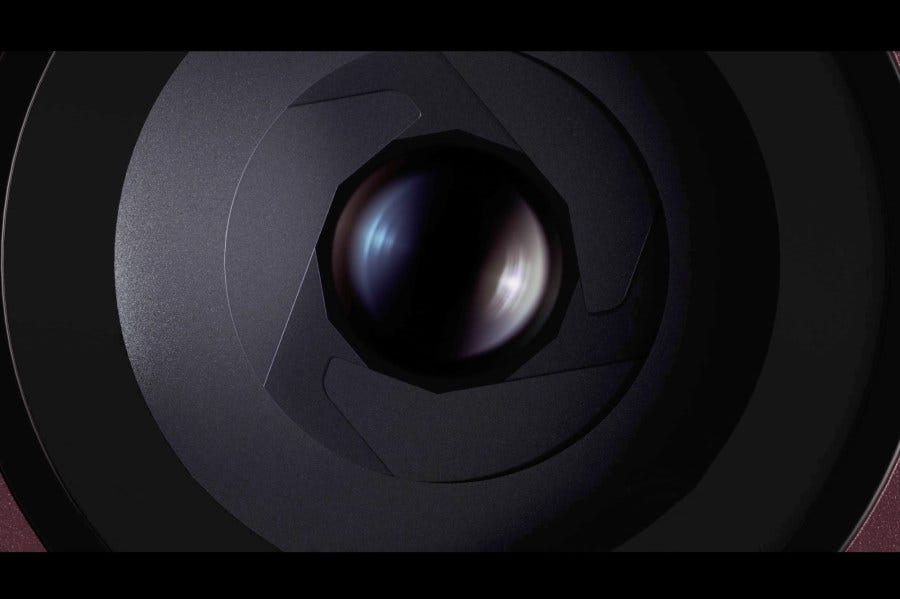
This is the one that got me. The iPhone 18 Pro main camera has aperture blades. Six of them, each one thinner than a human hair.
If you’ve never shot with a “real” camera, here’s the quick version. The aperture is the hole light passes through on its way to the sensor. On a traditional camera, a ring of blades opens and closes that hole. Every iPhone before this one had a fixed hole. One size, all the time, and software did the rest.
The 18 Pro can shift between f/1.48, f/1.8, f/2.8, and f/4. Smaller number means a bigger opening. Here’s why that matters in real life:
Low light. Wide open at f/1.48, the lens pulls in a lot more light. Apple claims around 50% better low-light performance, which means faster shutter speeds, shorter Night mode waits, and fewer blurry photos of your kids at dinner.
Keeping everyone sharp. A wide-open lens gives you that blurry background, which is great for a portrait and terrible for a group shot. With a fixed wide aperture, if you’re close to someone and want the scene behind them in focus too, you lose it. Close down to f/2.8 or f/4 and more of the frame stays sharp. Two rows of people at a birthday dinner? Now they’re all in focus.
Real background blur. Portrait mode has always been software guessing where your subject ends and the background begins (hello, blurry ear). Now some of that blur comes from actual optics.
Starbursts. Close the aperture down at night and streetlights turn into those little star shapes. It’s a small thing. It’s also the kind of thing that used to require a real camera.
You don’t have to do any of this. The camera defaults to f/1.8 and picks for you. But when you want control, it’s there, and it’s mechanical, not a filter.
How does Apple fit adjustable aperture blades into a lens this small? I don’t know. And that’s exactly why I keep feeding them money.
Skipped the 17 Pro? This Is a No-Brainer.
If you’re coming from an iPhone 16 Pro or older, you’re not just getting aperture blades. You’re also getting the telephoto camera Apple introduced last year.
The 16 Pro had a 12MP 5x telephoto. The 17 Pro replaced it with a much bigger 48MP 4x telephoto, and because of all those extra pixels it can crop to 8x optical-quality zoom without turning your photo into mush. The 18 Pro keeps that camera.
So if you skipped a year, you get two years of camera upgrades in one jump: 8x zoom and variable aperture. That’s an easy call.
My Phone Is a Rental
People sometimes ask how I justify a new iPhone every year. Simple: I don’t think of it as buying a phone. I think of it as renting one.
I buy the new iPhone, trade in last year’s, and my real cost is just the difference. Here’s the math using Apple’s own trade-in values right now:
iPhone 18 Pro $1,199
iPhone 17 Pro trade-in credit−$785
Cost for a year of the latest iPhone $414
Per month about $35
That’s roughly what I pay for a streaming service or two, for the device I use more than anything else I own. And I’m always on the latest.
Skipped a year? A 16 Pro trades in for $510, so you’re looking at $689 for the upgrade, or about $29 a month across the two years you owned it. Also not bad.
Two Phones, Two Lives
I carry a work phone and a personal phone. I like keeping those two separate. When I put the work phone down, work is actually down.
I know, Android folks love to point out that they have work profiles and can do this on one device. That’s great for you. Android ain’t for me.
The Little Things
It’s got a new Dynamic Island, about a third smaller than before because Apple moved some of the Face ID parts under the screen. It’s kind of nice. It’s less in the way when you’re watching video, and it can show up to three Live Activities at once. It’s not the reason to upgrade, but it’s a nice touch.
Did I mention it’s black?
Up Next: The Duo
I’m getting a Duo. Now I just need to figure out how to justify having an iPhone 18 Pro and a Duo. I’m sure I’ll come up with something.
Stay tuned.
I built another app and I adore it. Daycard is a paper feel app for Apple Reminders. It focuses on showing you “Today”.
Feedback so far has been great! I plan to write about it soon.
Thank you Omar.
Looking fwd to reading about "Now I just need to figure out how to justify having an iPhone 18 Pro and a Duo. I’m sure I’ll come up with something." ;-)